
logo
  • About
  • View the full timeline
  • Newsletter
  • Donate
  • About
  • View the full timeline
  • Newsletter
  • Donate
315,000 Years Ago
The earliest known humans emerge and live on the African continent.
All human beings today belong to the Homo sapiens species, and it is widely accepted amongst researchers, historians, and scientists, that all of human history began on the continent of Africa. The exact location in Africa is a topic of constant debate as remains have been found in various locations throughout the continent, such as Ethiopia, Kenya, and Morocco, though researchers suggest it was most likely in the Horn of Africa. The oldest known remains of our species to date has been found in Jebel Irhoud, Morocco and dated about 315,000 years ago.
250,000 Years Ago
Modern humans begin to disperse and migrate out of Africa.
Early modern humans expanded to Western Eurasia and Central, Western and Southern Africa from the time of their emergence. Evidence of migration out of Africa, via a partial skull, was discovered in the Apidima Cave in southern Greece and is dated more than 210,000 years old. There were several waves of migrations, many via northern Africa and the Arabian Peninsula about 130,000 YA (Years Ago), though most of these early waves appear to have mostly died out or retreated by 80,000 YA.
c. 200,000 - 130,000 Years Ago
Mitochondrial Eve, the most recent woman from whom all living humans descend, lives in Sub-Saharan Africa.
Mitochondrial Eve (the name alludes to the biblical Eve) is the matrilineal most recent common ancestor of all living humans. In other words, she is defined as the most recent woman from whom all living humans descend in an unbroken line purely through their mothers and through the mothers of those mothers, back until all lines converge on one woman. In 1987, geneticists compared the mitochondrial DNA (genetic information passed from mothers to their offspring) of people from different populations around the world and find that they all link in an unbroken line to Mitochondrial Eve. This does not mean that she was the first woman, nor the only living female of her time, nor the first member of a "new species." It only means that she is the most recent female ancestor to which all living humans are linked. She was believed to have lived in either East Africa or Botswana.
c. 10,000 BC - 6,000 BC
Due to a tilt in the Earth’s axis, the Sahara transforms from a humid region rich with grasslands and water, to an arid desert, prompting Saharan Africans to migrate to the Nile Valley.
The earliest Egyptians were indigenous Africans who were drawn to the Sahara when it was a humid region rich in grasslands and with plentiful water. There was a widespread Saharan Neolithic culture. However, during this same period (c. 10,000 - c. 6,000 BC), the Earth's axis tilted, causing the Saharan climate to slowly transform from humid to arid, prompting Saharan Africans to migrate to the Nile Valley to take advantage of its fertile floodplains.
❌

Home / Full timeline / The U.S. Supreme Court rules against affirmative action programs in Florida and Michigan.

The U.S. Supreme Court rules against affirmative action programs in Florida and Michigan.; ?> The U.S. Supreme Court rules against affirmative action programs in Florida and Michigan.

1989 (Mar 6)

Share on Facebook Share on Twitter Share on LinkedIn

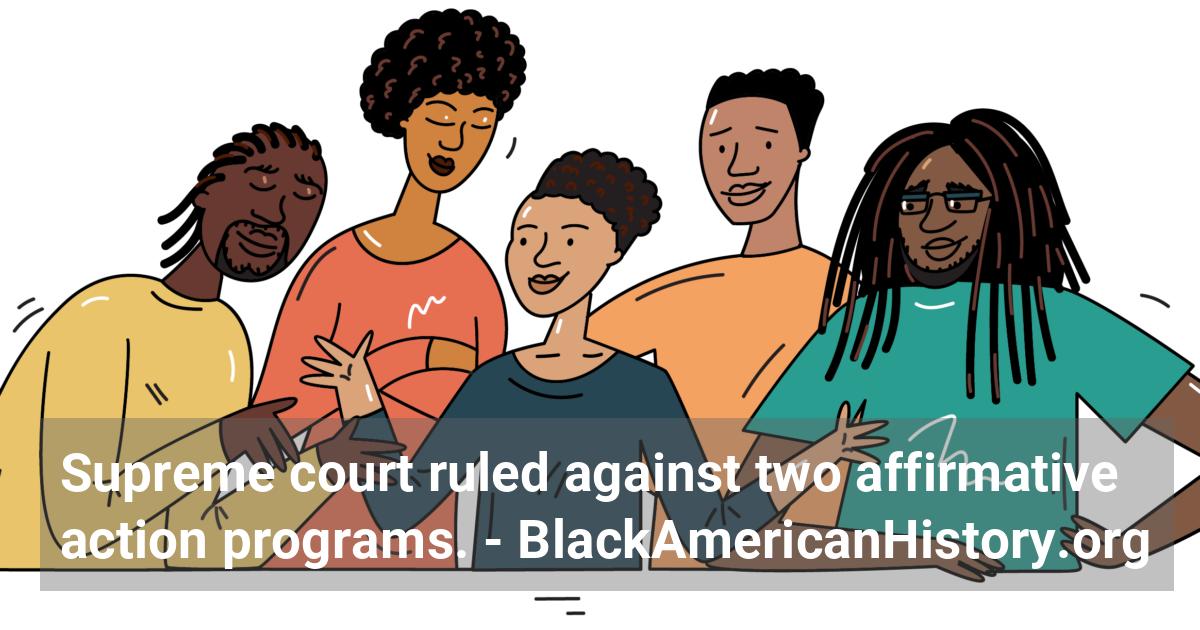
The U.S. Supreme Court ruled against affirmative action programs in Florida and Michigan. In the Florida case, the Court heard an appeal of a ruling from the U.S. Court of Appeals for the Eleventh Circuit which had upheld a set-aside plan for minorities in Dade County, Florida. Under the plan, which was adopted in 1979, in order to qualify for federal funds for a mass transit project, the county had to set aside 5 percent of construction contracts for minorities. But after a low bid on a construction project by the H. K. Porter Co. was rejected because the county did not meet the 5 percent goal, Porter sued. In light of its recent ruling in an affirmative action case from Richmond, Virginia, however, the Supreme Court vacated the decision of the appeals court and ordered it to reexamine the case of Porter v. Metropolitan Dade County. In the Michigan case, the Court affirmed without a written opinion a ruling by the U.S. Court of Appeals for the Sixth Circuit which declared a Michigan law unconstitutional. That act, adopted in 1981, provided that 7 percent of state contracting expenditures should go to minority-owned businesses and an additional 5 percent to businesses owned by women. Although the state argued in its appeal of Milliken v. Michigan Road Builders that the set-aside percentages were carefully selected “to redress discriminatory practices by state agencies," the supreme court still ruled against it.

References:

  •  • Hornsby, Alton. Chronology of African-American History: Significant Events and People from 1619 to the Present. Detroit: Gale Research, 1995.
©blackamericanhistory.org, 2021-2026 Privacy policy
Sitemap
icon
8311 Brier Creek Pkwy Suite 105-152 Raleigh, NC 27617
icon
919-858-2410
icon
hello@blackamericanhistory.org